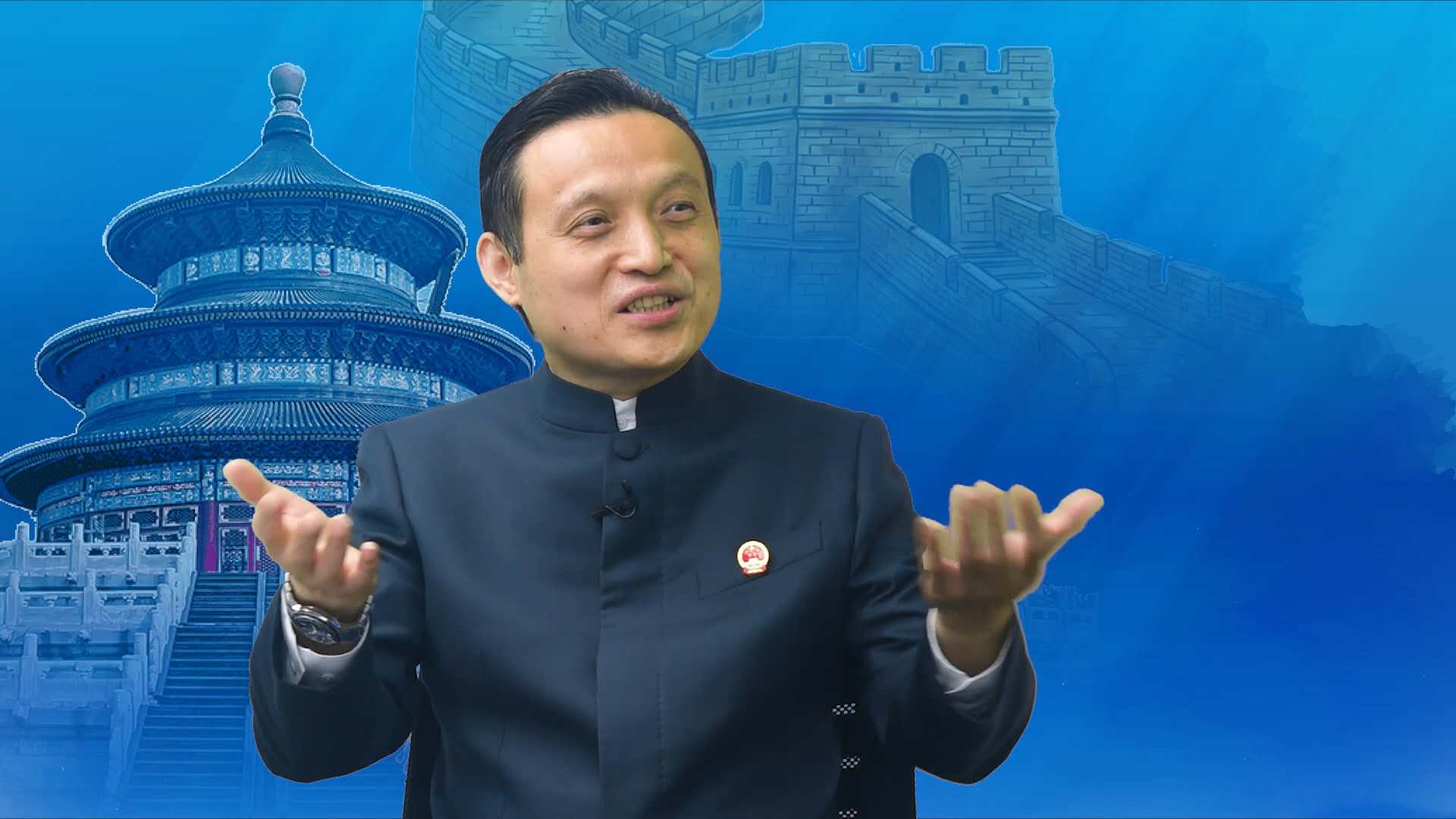
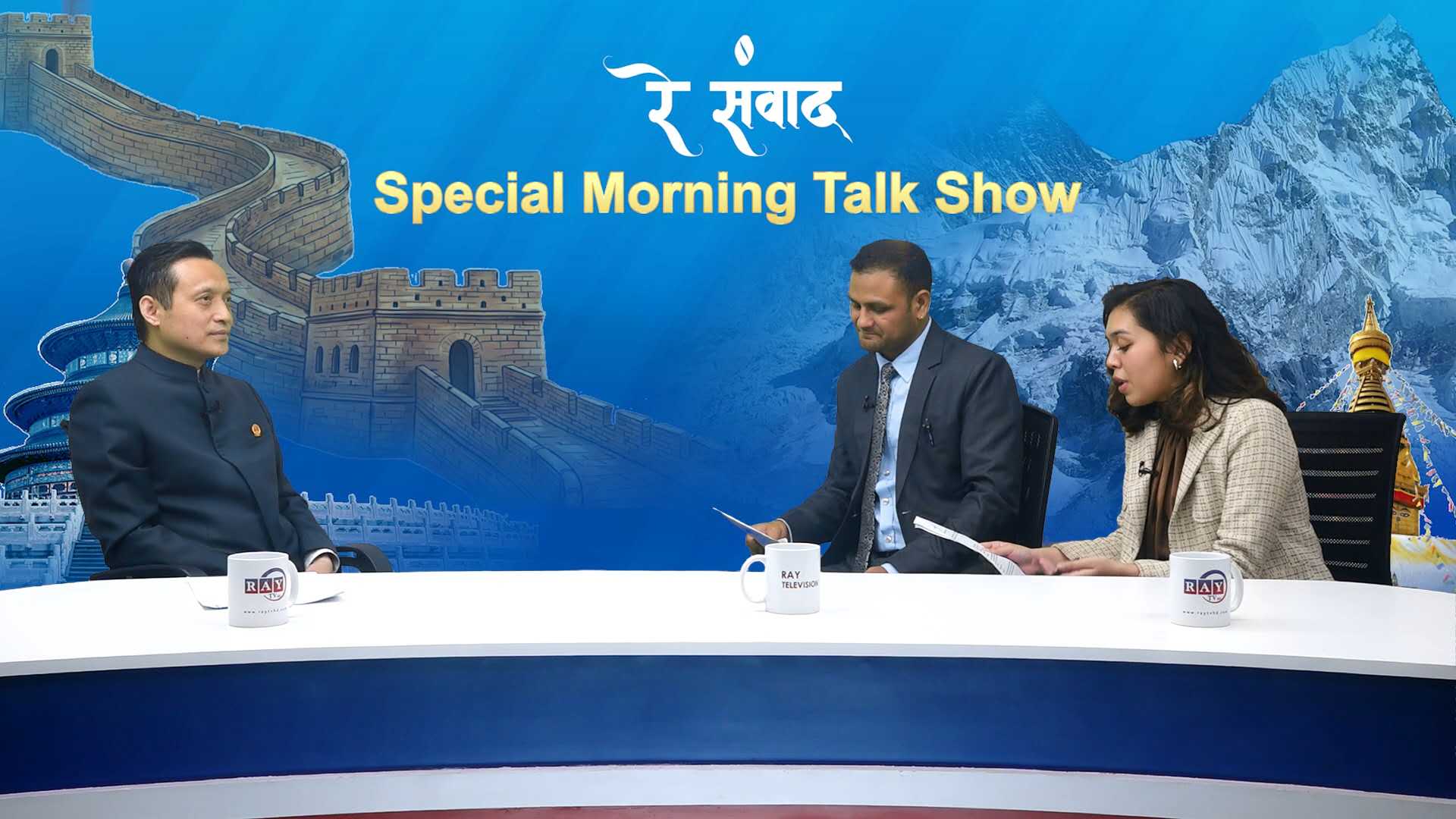
“An exclusive and special interview given by His Excellency Zhang Maoming, Ambassador of China to Nepal, to Ray Television journalists Roshan KC and Upama Paudel, on important topics such as Nepal’s changing political situation, the official view of the Chinese government toward the newly formed Rastriya Swatantra Party (RSP) government of Nepal led by Prime Minister Balendra Shah, and the benefits Nepal can gain from China’s development.”
First of all, thank you for your time. You arrived in Nepal on February 13 this year, at the beginning of the Chinese New Year. It has already been more than a month. Could you share your impressions with us?
Thank you. You have got so exact information about my arrival! When I arrived in Nepal in February, it did coincide with the Chinese New Year. The Chinese Embassy organized a series of celebrations, and I was delighted to share this joyful occasion with the Nepali people other than just my family members. Since my arrival, I have truly felt the warmth, kindness, and friendship of the Nepali people as well as the beauty, vitality and potential of this wonderful country.
As the Nepali New Year approaches, I would like to take this opportunity to extend my sincere wishes to the Nepali people for a very happy, healthy, peaceful and prosperous New Year.
1. General Election of Nepal
Nepal’s House of Representatives election was recently held smoothly, with the Rastriya Swatantra Party (RSP) achieving an overwhelming victory. What is your view on this election and its potential impact?
China sincerely congratulates Nepal on the smooth and orderly conduct of its House of Representatives election. As a traditional friendly neighbor of Nepal, China has always respected and supported Nepal in independently choosing a development path suited to its national conditions.
"China will continue to support Nepal in safeguarding its own sovereignty and development interests, and looks forward to working with the new government to further deepen pragmatic cooperation across various fields and advance bilateral friendly relations."
- Chinese Ambassador to Nepal His Excellency Mr. Zhang Maoming
The remarkable victory of the RSP in the election reflects the strong aspirations of the Nepali people—especially the younger generation—for reform, development and good governance. China believes that with the formation of new government, all political forces in Nepal will put the interests of the country and its people first, and work together in unity to promote political stability and economic development in Nepal.
2. Bilateral Relations
The friendship between Nepal and China has a long history, and both countries have consistently upheld their political commitments to enhancing bilateral relations. What is your view on the China-Nepal relations after the formation of the Nepali new government?
As you just said, since the establishment of diplomatic relations between China and Nepal on the basis of the Five Principles of Peaceful Coexistence in 1955, China and Nepal have always supported each other on issues concerning core interests and stood shoulder to shoulder in the face of challenges, regardless of the changes in the international landscape or domestic situations in our two countries. Developing China-Nepal friendship with upholding the One-China principle has become a broad consensus among political parties and people from all walks of life in Nepal.
RSP, the majority party in the House of Representatives of Nepal, states in its election manifesto that it will pursue a balanced and dynamic diplomacy and act as a vibrant bridge between China and India. This is in line with our joint efforts to advance High-quality Belt and Road cooperation, promote common development, and improve the well-being of our two peoples. It also aligns with the vision of building a China-Nepal community with a shared future. China will continue to support Nepal in safeguarding its own sovereignty and development interests, and looks forward to working with the new government to further deepen pragmatic cooperation across various fields and advance bilateral friendly relations.
3. Nepalese youth
In the Gen Z movement last September, Nepalese youth demonstrated a strong desire to promote national development. Many young candidates entered parliament in this election. What are your hopes and messages for Nepalese youth?
The future of the nation lies in its youth, and the hope of the nation lies in its youth. In this election, Nepalese youth demonstrated vibrant energy and a strong desire for national modernization. It’s glad to see that Nepalese youth participate in national development with innovative thinking and a pragmatic spirit.
China has always attached great importance to youth exchanges with friendly neighbors. We are willing to strengthen exchanges with Nepalese new leadership on governance and development experience and to expand cooperation in areas such as digital economy, artificial intelligence and agricultural modernization. We also welcome more young Nepalese entrepreneurs, experts, and students to visit China for exchanges and learning, and to carry forward the friendship that transcends the Himalayas through mutual acquaintance and affection.
1. General Questions
The Two Sessions are a major event in China’s political life, which will set the tone for China’s policy direction and have a significant impact on national economy and people’s livelihoods. Could you make a brief introduction of the Two Sessions?
The Two Sessions refer to the annual plenary meetings of China’s two top political bodies: the National People’s Congress (NPC) and the Chinese People’s Political Consultative Conference (CPPCC). The NPC, as the highest legislative body, is responsible for passing laws, approving budgets, and overseeing the work of the government. The CPPCC, on the other hand, serves as a key political advisory body, bringing together representatives from various political parties, organizations, and sectors to discuss and provide input on major national policies. These meetings offer a vital window for the world to observe China’s development trajectory and governance model. They are a comprehensive manifestation of the people’s democracy and reflect the collective decision-making process that guides the country forward.
Among the most significant outcomes of this year’s Two Sessions is the formal deliberation and approval of the 15th Five-Year Plan (2026-2030) for National Economic and Social Development. This visionary blueprint outlines China’s medium-to-long-term strategic priorities, focusing on high-quality development, technological self-reliance, and the steady advancement of Chinese modernization. As such, the Two Sessions play an indispensable role in mobilizing the will of the people, consolidating social consensus, and ensuring that the nation’s policies align with the fundamental interests of the people, thereby injecting strong political momentum into the realization of national development goals and the Chinese Dream of the great rejuvenation of the Chinese nation.
2. Economy
The 15th Five-Year Plan sets the direction for China’s development over the next five years. It is also a critical period for basically achieving socialist modernization by 2035. How will the 15th Five-Year Plan create opportunities for the rest of the world?
The 15th Five-Year Plan is not only a grand blueprint for the country’s development over the next five years, but also a significant opportunity for the world. First, by advancing high-standard opening up, China will further lower market barriers in sectors such as telecommunications, healthcare, and culture, creating a more transparent and predictable business environment for foreign investors. Second, as China accelerates its drive for technological innovation and green transition, it generates vast global demand for joint research, cross-border talent exchange, and clean energy cooperation. Third, with its stable policy framework and super-large market, China will continue to serve as a major engine for global growth, providing much-needed certainty and momentum to the world economy.
China and Nepal are good partners seeking common development. The Chinese side stands ready to work with Nepal, deepening cooperation and exchanges in various areas, bringing more benefits to the peoples of our two countries, advancing China-Nepal Strategic Partnership of Cooperation Featuring Ever-lasting Friendship for Development and Prosperity to a new height.
3. Technology and Innovation
Innovation and high-tech development have been central themes in recent Two Sessions. How will China strengthen its technological independence, including in the emerging industries like AI?
Chinese modernization must be underpinned by modernization in science and technology. The outline of the 15th Five-Year Plan proposes achieving greater self-reliance and strength in science and technology, building a modernized industrial system with advanced manufacturing, strengthening original innovation and making breakthroughs in key core technologies. It sets clear targets, including an average annual growth rate of over 7% for total Research and Development spending, raising the value added of core digital economy industries to 12.5% of GDP, and a cumulative reduction of 17% in CO2 emissions per unit of GDP.
You have mentioned AI. AI is becoming a powerful engine for China’s high-quality economic development. Over the past year, the output of China’s core AI industry exceeded 1.2 trillion yuan (165 billion U.S. dollars), with more than 6,200 companies operating in the sector. Chinese open-source AI models have recorded the highest number of downloads globally, and AI technologies are being applied in over 30% of large-scale manufacturing enterprises. China will promote AI Plus Initiative, encouraging all sectors of the manufacturing industry to embrace AI and deeply explore high-value application scenarios. By the end of the 15th Five-Year Plan period, China’s AI related industries will be valued at more than 10 trillion yuan (1.45 trillion U.S. dollars). At the same time, China will uphold international cooperation and open sharing in AI, working with all countries to jointly explore and build a more broadly accepted AI governance framework and rules, so that AI can better benefit humanity and become a global public good.
4. Foreign Policy
How does the Two Sessions shape China’s approach to international diplomacy in 2026? What role will China play in promoting multilateral cooperation and global stability? How does China plan to strengthen cooperation with Global South countries, including Nepal after the Two Sessions?
In 2026, with the start of the 15th Five-Year Plan, China’s diplomacy will enter a new stage where we can make greater contributions to the development and progress of humanity.
First, We will provide stronger strategic support for our national development and rejuvenation. It is an important mission for China’s diplomacy to facilitate a good start to the 15th Five-Year Plan.
Also, We will work more actively to build a community with a shared future for humanity. In today’s world, changes unseen in a century are unfolding at a faster pace, transformation and turbulence are intertwined. As the world’s most important force for peace, stability and justice, China will practice true multilateralism and remain a steadfast defender and contributor to the current international system. We will work with all sides to strengthen the authority and standing of the U.N., uphold the purposes and principles of the U.N. Charter, and support the U.N. in playing the central role on major issues concerning world peace and development.
For Global South countries, multilateralism is vital, and an open and cooperative international environment for development is crucial. China’s heart is with the Global South; China’s root is in the Global South. China stands ready to advocate a universally beneficial and inclusive economic globalization, foster an open world economy, firmly uphold the multilateral trading system, and promote openness to shared opportunities and achieve win-win outcomes with Global South countries.
For neighboring countries including Nepal, China will follow the principles of amity, sincerity, mutual benefit and inclusiveness. By promoting common security, managing disputes properly, mediating hot spot issues, and deepening cooperation in trade, ecology, and culture, China stands ready join hands with our neighbors to build a peaceful, safe, prosperous, beautiful and amicable home under the goal of building a community with a shared future with neighboring countries.
5. Global Cooperation
In the context of global geopolitical tensions and economic fragmentation, how does China plan to contribute to global development? What progress can we expect in projects related to the Belt and Road Initiative?
The world economy is facing headwinds, and globalization is suffering a backlash. The problems can only be addressed through more sustainable development and more equitable and effective governance. To this end, President Xi Jinping has called for promoting an economic globalization that is universally beneficial and inclusive.
The 15th Five-Year Plan is the new blueprint for China’s development and it offers a new vision for the win-win cooperation around the world. China will adhere to high-standard opening up, continue to share the benefits of its super large market with the world, lead the trend of global openness and cooperation to counter decoupling and isolation.
Regarding the cooperation between our two countries, China will advance High-quality Belt and Road cooperation by better coordinating major signature projects and “small and beautiful” livelihood programs, and properly addressing disruptions and difficulties along the way. We will follow the principles of amity, sincerity, mutual benefit and inclusiveness, and work together with all Nepali friends to implement the important common understandings reached between President Xi Jinping and Nepali leaders, to promote practical cooperation in all sectors, and to jointly write a new chapter in China-Nepal friendship.